How to choose a used sea-going yacht
Which sea-going yacht should you buy? New or used? Or perhaps a catamaran, or even a motor yacht? Once the choice falls on a new boat, buying it looks reasonably straightforward. The difficulties start when the budget is tight and the dream of “settling down” has to be met with a used yacht. What should you look at to make sure the purchase still pleases you years later?
Let us assume the question of hull material — wood, metal or GRP — has already been settled. So let us weigh up the pros and cons of buying a used laminate yacht. The people who come to me as a broker usually have a budget in mind and very specific expectations: they know what type of yacht interests them and the range of build years, and they know exactly which waters they will be sailing. What they still do not know is where to buy and what to watch out for. My conclusions come from several years of professional brokerage work and are mostly based on statistics. There will always be exceptions, in both directions.
Where to look
There are plenty of listing sites and brokers offering used yachts today. When looking at boats from their stock, the first thing worth establishing is which waters the boat has sailed so far. What does that tell you? Some waters are simply harder on a boat. Conditions in the North Sea and on the ocean are quite different from the Adriatic, or even the Mediterranean.
Yachts from the Adriatic and the Mediterranean have less tired hulls and standing rigging; those from the North Sea are noticeably more worn. Every slam into a wave is carried not only by the hull, but also by the mast and the rigging. And while everyone checks the hull, nobody has ever asked me about the standing rigging — occasionally, though rarely, someone asks about the mast. A damaged mast, if it is bent, will end up costing far more than an engine repair, even a full rebuild. Repairing a shaft or a keel is expensive too.
Whatever waters a laminate yacht has sailed, you must check the hull for osmosis. You do not necessarily have to lift the boat out to do so — osmosis is a chemical reaction, so before you see blisters in the laminate you will smell something like vinegar. Open the bilges and check. That alone can keep several thousand in your pocket, especially if you are viewing a number of boats. One thing that should raise suspicion here is a strong smell of air freshener in the bilge, masking the real odour.
Autor: Edyta Jakubczak
Who owned it before
This is the biggest dilemma of all — buy from a charter company or from a private owner? A private owner will usually have used the boat less (although there are exceptions and it does not pay to generalise). From experience I know that private owners do not keep a fixed service schedule for the engine, the underwater gear, or the electrical and water systems. They do the work because something has broken and there is no way around it. It is also hard to check the history — whether the boat has been through any major repairs, for instance. The insurance history of a private yacht is difficult to verify and easy to distort. Private owners change insurers more often than charter companies do. On the other hand, private boats are without doubt generally better equipped than charter ones.
A charter company will certainly have used the boat harder, but its service intervals are fixed in advance by schedule. So on charter yachts you can expect regular servicing of the underwater gear, engines, shafts, keels, standing rigging and everything else. Repairs are also rarely done with second-hand parts and equipment. The reason is simple: companies know that once the season starts there will be no time for lengthy repairs, so everything that can be done must be done during the service window. On top of that, yachts approved for commercial use have to undergo regular technical inspections, the frequency of which varies with the country of registration. They are more or less thorough, but they have to happen — while private boats are under no obligation to undergo them at all. In some countries they are compulsory only before the yacht is registered.
A charter company will sell you a less well-equipped yacht, but it is easier to reach an agreement with them at the point of purchase to leave you the liferaft, the tender with its outboard and all the additional equipment. Not everyone will go along with that, of course, but it is by no means rare to buy a used boat this way — fully equipped and freshly serviced.
Some companies look after their yachts better than others, which is usually reflected in charter prices. The good ones put more money into servicing, with every client contributing a little, and the standard of repair is generally higher than at the cheaper operators. So you can assume that the expensive charter companies are the ones that take better care of their fleet. You have surely wondered more than once why yachts from some companies look better at ten years old than five-year-old boats from another. It all comes down to the owner, according to the old rule that you get what you look after — and looking after equipment costs money.
Older and bigger, or newer and smaller
Here it is not price that plays the leading role, but your own needs and preferences. It is no secret at sea that boatbuilders once made the interior joinery from timber, whereas today they use board. Laminate used to be thicker; today boats weigh a couple of tonnes less — a 45-foot catamaran has almost the same displacement as a 38-foot one did a few years ago. New technologies and materials mean yachts are built differently and are more durable, and certainly faster. But yachts are now also designed for particular waters and conditions. Older designs were more universal, and that is worth bearing in mind — and I am not writing here about boats from forty years ago, but about yachts of around fifteen years and a little younger.
Autor: Edyta Jakubczak
A checklist and an expert
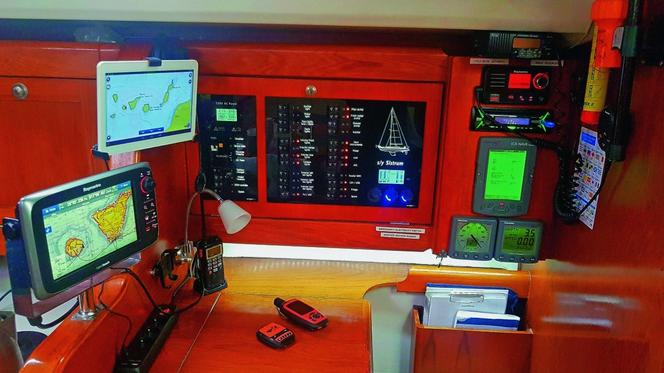
Before you start viewing a yacht, prepare a list of points to check, then work through it item by item. Without one you will lose focus quickly and miss obvious faults. As in every trade, I also recommend calling on experts — people with experience. Most clients viewing a boat for sale spend their time looking at the engine and the bilge, or counting chartplotters and deck electronics. What nobody usually knows is that replacing a water heater costs 700 euros — and who remembers to check it? Replacing a forestay costs 1,400 euros, and few people check that either. There is a great deal that distracts us: the sails, for instance, and then we forget the standing rigging. In the same way, looking at the running rigging draws our attention away from the mast, inspecting the engine away from the shaft, osmosis and the state of the laminate away from the rudder blade. And repairing a rudder blade is neither easy, nor quick, nor cheap. Then there are the unwanted animals that can take up residence on boats from various — and not especially exotic — waters. Getting rid of them is extremely troublesome.
Checking everything clearly takes enormous effort, so something can always slip through. A good broker will take much of this off your hands, help you build the checklist, and bring their experience to bear on inspecting the yacht thoroughly. A broker is far more than a salesperson who arranges a viewing and sends an invoice.
Although only part of the original wish list for a dream yacht usually survives, it is worth having as much information as possible so that you can make a good decision knowingly. Then the saying that “a yacht owner is happy only twice — when he buys her and when he finally sells her” will not come true, while another popular saying will always hold: you saw what you were buying. Better, then, not to learn from your own mistakes, but from other people’s experience.
O autorze: kpt. Edyta Kos-Jakubczak, together with her husband Adam and their daughter Kalina, spends almost the entire year at sea, organising cruises and working professionally in yacht brokerage, registration and insurance.