Sailing licences — which one to go for, and how
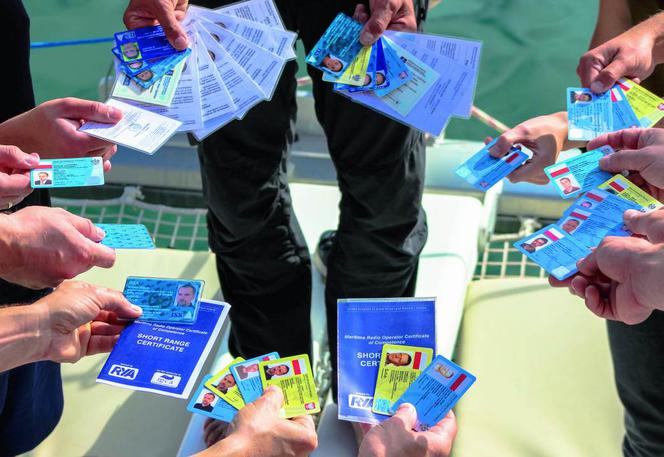
There is never a bad moment to build on your sailing knowledge. To combine the pleasant with the useful, it is worth considering gaining or extending your sailing qualifications — in other words, a new licence. There are plenty of options today: you can apply for the Polish PZŻ licence, the Croatian Voditelj Brodice, the British RYA and several others. Which one opens the most doors?
Experience, skills and qualifications — these are the three areas every person who plans to run, or already runs, voyages as a skipper should develop. Poland has recently seen changes in the rules covering people sailing in that capacity. In March 2018 the Ministry of Maritime Economy and Inland Navigation introduced a new regulation on the requirements for crew members and skippers of commercial voyages. The document makes it quite clear in which direction it is worth developing your skills, particularly if you decide to run commercial trips (http://dziennikustaw.gov.pl/du/2018/490/1).
Autor: Adam Jakubczak
Under the least favourable readings of the regulation, a commercial voyage is one in which the skipper does not fully share in the contributions and costs of the yacht, as well as one in which the skipper earns money from the trip.
From which follows a simple conclusion: if you want to skipper a yacht, you need to build experience, develop your skills and extend your qualifications.
Practice and building knowledge
Any sensible person will agree that practice makes perfect. But where can you practise sailing when the weather outside is what it is? Not long ago we treated winter as a dead season; now there is a choice of professional mileage-building voyages in waters that offer perfectly decent sailing conditions during the Polish winter. You can pick trips that offer not only active time off in demanding waters but also genuine sail training. The steadily widening range means there really is a lot of interesting and varied training to choose from. Bear in mind, though, that not every voyage delivers the same experience, however similar they may look on paper.
There are more and more schools running professional courses at every level of a great many training systems — and without any guarantee of passing the exam. Training is where we acquire the skills our safety depends on, so the exam has to verify that we actually have them. When you take your family to sea, you may regret it if the training and the exam were neither fair nor demanding. You should always be able to look after the safety of the people sailing with you. Make sure it is not too late to learn by then. And the necessary foundation for all this is holding the right qualifications.
Which licence to choose
There are several training systems available today, and with them several licences and qualifications permitting you to skipper a yacht. Let us go through the most important and most popular ones.
Most European countries have their own training systems, but the licences differ from country to country both in what is required to obtain them and in what they permit. In most countries — including Poland under the PZŻ system — exams must be taken in the national language, but that is not true everywhere. In Croatia and Greece you can sit the exam in English or even in Polish. Thanks to that convenience, many Poles sailing the Adriatic opt for those qualifications. In the countries bordering the Adriatic, the best recognised and most readily accepted licences are, naturally, the national ones of the places where we sail.
You also often meet sailors at sea holding licences issued in other countries. There is no clear-cut way of saying whether they are better or worse, since the training systems behind them frequently differ a great deal. It is not the certificate that makes the skipper — but without one you are not allowed to sail. Exams exist to confirm a skipper’s experience and knowledge objectively.
Autor: Adam Jakubczak
We have to remember that both licences, the Polish and the Croatian, permit only private, non-commercial voyages at skipper level. Commercial voyages in Poland require separate qualifications, which can be obtained at the Maritime Academy in Gdynia. They are fairly expensive, however, and obtaining them also requires many months of experience on vessels over 15 m (details on the school’s website: http://morska.edu.pl/pl/page/163/lista-kursow-zeglarskich).
In the Croatian system, by contrast, the C Voditelj Brodice licence — the equivalent of the Polish Yacht Master — allows you to run yachts commercially up to 30 gross tonnes.
It is worth knowing that the great majority of countries which adopted Resolution No. 40 of the United Nations Economic Commission for Europe, setting out the requirements for international competence in recreational boating, may issue an International Certificate of Competence (ICC) on the basis of national licences. The certificate covers recreational boating, but it is also required by many companies employing sailors and skippers. So in many countries you will come across the unified ICC, and in the long run this certificate is meant to be required for chartering and insurance in every country that adopted Resolution 40. Unfortunately Poland did not adopt it, so PZŻ licences cannot be converted to the ICC.
Below we set out a comparison of the Polish PZŻ system and the Croatian Voditelj Brodice system. The data comes from the official websites of both training systems.
Certificates from well-known schools
The training systems run by international federations of schools are becoming increasingly popular; the best known in Europe are the British RYA and ISSA. Besides qualifications corresponding to the Polish and Croatian licences (see the table), they also award certificates confirming basic sailing skills or attesting that the holder can serve as a trained crew member — “Crew Yacht” in ISSA, and “Start Yachting” and “Competent Crew” in the RYA.
Anyone planning to sail in United States waters should know that, as in Poland, Resolution No. 40 was not adopted there and the ICC cannot be obtained in the USA. Charter companies do not require it, although it is welcome when renting a yacht.
In the United States the ASA training system (American Sailing Association, https://asa.com/) has become widely popular. Since it is difficult to convert American qualifications to the ICC, a new International Proficiency Certificate (IPC) was introduced so that holders could work with European charter companies; it can be obtained on the basis of ASA qualifications.
The American IPC, like the European ICC, is ultimately intended to be required by all charter and insurance companies. It may make it possible to achieve comparable experience, skills and knowledge across Europe and America at every level of qualification.
The published comparison of ISSA and RYA requirements is based on the official websites of both training systems.